Photography robots have moved beyond the camera shutter. The useful work now sits in motion control, subject tracking, repeatable framing, and safe operation around people. Without a supplied evidence pack, this article focuses on the technical changes that define progress rather than naming products or claiming a market winner.
- Repeatable camera movement matters more than raw speed.
- Subject tracking only helps when the robot keeps the lens pointed correctly.
- Safety, setup time, and recovery after an error decide whether a rig earns its space.
Camera movement became programmable
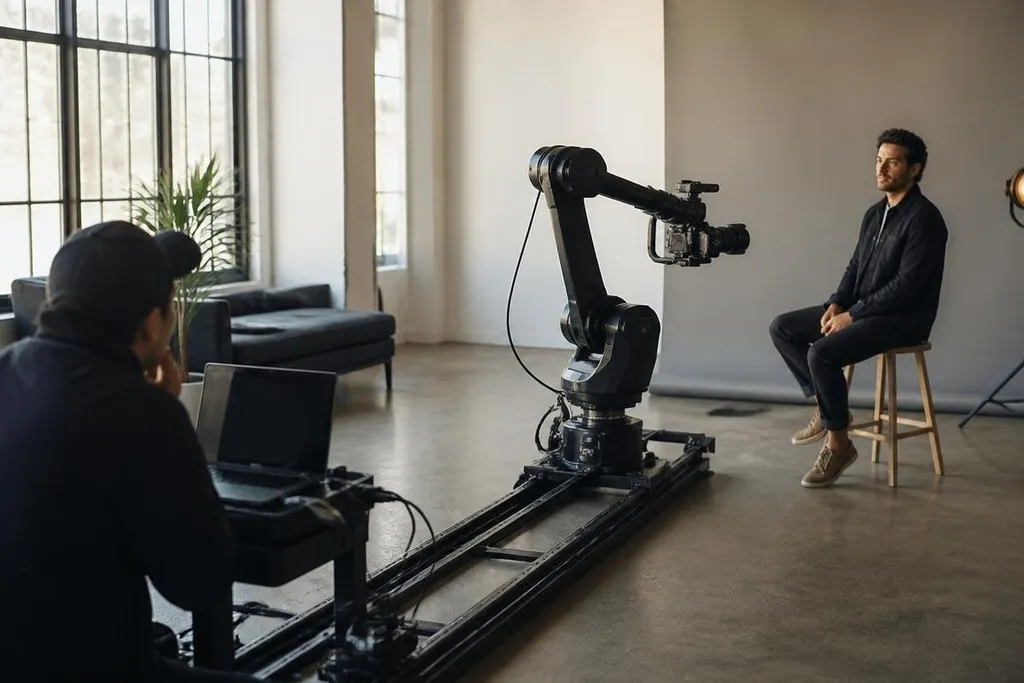
A robotic camera rig can move along a rail, rotate on a pan-and-tilt head, or control a multi-axis arm. The useful change is repeatability: the same move can run again with the same start point, speed, and end point.
That matters for product shoots, sports clips, studio work, and time-lapse images. A camera operator can spend less time repeating a move by hand and more time checking focus, lighting, and the subject’s position.
The mechanism still has limits. A motor may reach the planned position while the lens points at the wrong part of the scene. Calibration has to connect the robot’s position with the camera’s view, or a precise move can produce a poor shot.
Tracking turned the camera into a moving observer
Subject tracking links image data with motor control. The camera sees a person or object, software estimates its position, and the robot changes its angle or path to keep that subject inside the frame.
This can reduce manual camera work during a moving shot. It also creates a new failure point: the system may follow the wrong object, lose the subject during an obstruction, or react too late when the subject changes direction.
A useful test needs more than a smooth clip. It should show the full sequence, including the moment the subject leaves view and the time needed to recover. A short demonstration can hide the part that matters most on a real set.
Dated Robot24.com photography robotics coverage can tie a camera robot’s claim to the full shot, operator role, and recovery time. That record shows whether the robot removed repeated camera work or shifted it to the crew.
Automation reduced repeated camera work
Photography has many tasks that follow a fixed pattern. A rig can repeat a product turntable move, place a camera at set points, or keep a fixed interval between shots. These jobs suit automation because the task can be written as a sequence of positions and waits.
The benefit depends on setup time. If a technician needs an hour to calibrate a rig for a ten-minute shoot, the robot may add work instead of removing it. The same system may make sense for a long production with many repeated shots.
Remote control also changes the working area. A camera can operate near a moving subject while the operator watches from a safer position, but remote control does not remove the need for an emergency stop or a clear space around the robot.
What still needs proof
The biggest claims in photography robotics often concern autonomy. A robot that follows a marked path in a studio has shown path following.
It has not yet shown that it can handle poor light, reflective surfaces, blocked views, loose cables, or people crossing its route.
I’d rank reliable recovery above higher speed. A slower rig that stops safely, reports the fault, and returns to a known position is more useful than a fast rig that needs a full reset after one tracking error.
The evidence gap is easy to describe. Product pages may list payload, movement range, camera weight, and control software, while leaving out setup time, failed takes, battery limits, and operator workload. Those missing details decide the cost of a shoot.
A buying checklist for a photography rig
Use these checks before you compare models:
- Define the shot: write down the camera weight, lens, movement, and repeat count.
- Check the control path: confirm whether the rig uses a handheld controller, computer software, or both.
- Test recovery: see what happens after tracking fails or the subject leaves the frame.
- Measure setup: record calibration time, not only the time of the finished move.
- Protect the set: check the emergency stop, cable routing, travel limits, and space around moving parts.
- Price the whole job: include mounting hardware, operator time, support, and replacement parts.
Photography robotics has made the camera more repeatable and more responsive, but the largest gains come from control that works every time. The next useful proof is not a faster demo; it is a full shoot with recorded setup time, failed takes, recovery steps, and the final cost per usable image.